
Gut-wrenching Moments in The Normal Heart
Lakewood Theatre Company’s production of Larry Kramer’s The Normal Heart does not leave a dry eye in the audience. Director Raven Arbuckle tackles a challenging show with a story worth telling. As Raven states in the Director’s Note: “It is also important to recognize that this story is not confined to the past. HIV and AIDS are still being diagnosed every day, even now in 2026. While medical advances have transformed what it means to live with HIV, stigma, inequality, and gaps in access to care persist. This play reminds us that the urgency, the activism, and the compassion it calls for are not relics of another time—they are still needed.” After seeing this performance, I felt inspired to research a lot about this era and also read the script through myself. This play offers an education on advocacy in and of itself!
“Albert was dead. Wait. It gets worse. The hospital doctors refused to examine him to put a cause of death on the death certificate, and without a death certificate the undertakers wouldn’t take him away, and neither would the police. Finally, some orderly comes in and stuffs Albert in a heavy-duty Glad Bag and motions us with his finger to follow and he puts him out in the back alley with the garbage. He says, ‘Hey, man. See what a big favor I’ve done for you, I got him out, I want fifty bucks.’ I paid him and then his mother and I carried the bag to her car and we finally found an undertaker who cremated him for a thousand dollars, no questions asked.”
I feel the strength of Kramer’s writing comes in his monologues. Jonathan Lovell in the role of Bruce Niles had audience members audibly sobbing as he shared about the horrific treatment he endured after the traumatic death of his partner, Albert. Halfway through Act 2, Casey Hardin powerfully delivers Dr. Emma Brookner’s words to the examining doctor as she once again implores health organizations for cooperation with research efforts and financial support to help her dying patients prior to flinging her case files at them. Bound to a wheelchair, Hardin’s portrayal of Dr. Brookner is a sheer force of nature at this point in the story. For anyone taking in this performance who has dealt with the crazy red tape of medical care and politics, you will want to shout out “Amen!” to this one. I would look forward to hopefully seeing more of Ms. Hardin in future productions in Middle Tennessee as she is a true diamond in the rough of dramatic actresses.
“You guys have all the money, call the shots, shut everybody out, and then operate behind closed doors. I am taking care of more victims of this epidemic than anyone in the world. We have more accumulated test results, more data, more frozen blood samples, more experience! How can you not fund my research or invite me to participate in yours? A promising virus has already been discovered—in France. Why are we being told not to cooperate with the French? Why are you refusing to cooperate with the French? Just so you can steal a Nobel Prize? Your National Institutes of Health received my first request for research money two years ago. It took you one year just to print up application forms. It’s taken you two and a half years from my first reported case just to show up here to take a look. The paltry amount of money you are making us beg for—from the four billion dollars you are given each and every year— won’t come to anyone until only God knows when. Any way you add all this up, it is an unconscionable delay and has never, never existed in any other health emergency during this entire century. ”
As someone who has loved ones who suffer from HIV, this production touched my soul throughout. I found Mickey Marcus (portrayed by the talented Jared Doegey) to be particularly relatable. As Doegey brilliantly departs Mickey’s happy-go-lucky norm to spiral into a full-blown panic attack, I recalled many of the conversations I had with friends and colleagues of my own who were still in NYC during the COVID epidemic as we lost 8 people we knew very early on. [Please note, I am not comparing the COVID epidemic to the AIDS crisis as I am aware there are many differences, especially in how the medical and political communities reacted. I am simply pointing out the relatable humanity of his emotions during this moment of the show.] This performance makes us confront firsthand how sometimes it’s hard to have clarity during the chaos of our world.
“I used to love my country. The Native received an anonymous letter describing top secret Defense Department experiments at Fort Detrick, Maryland, that have produced a virus that can destroy the immune system. Its code name is Firm Hand. They started testing in 1978 — on a group of gays. I never used to believe shit like this before. They are going to persecute us! Cancel our health insurance. Test our blood to see if we’re pure. Lock us up. Stone us in the streets. And you think I am killing people? ”
The standout performance of this production was Reed Clapp in the role of Felix Turner. His command of this character was so natural that you felt like you were a fly on the wall of his everyday life. Clapp’s portrayal of Felix’s journey from successful New York Times journalist to chill lover to a man dying of AIDS was nothing short of impressive. The height of his performance was during his scene with another standout actor, John Carpenter, in the role of Ben. This is the first time Felix meets Ben, a lawyer and the brother of his partner, Ned, to get his will in order as he is near death. It is bittersweet as Ben tells him: “I wish I had met you sooner.” Carpenter offers a masterclass in dramatic acting showing a genuine desire to support his brother while also not wanting to risk reputation damage in his own personal and professional life. It’s a sibling story that we see play out all too often in life.
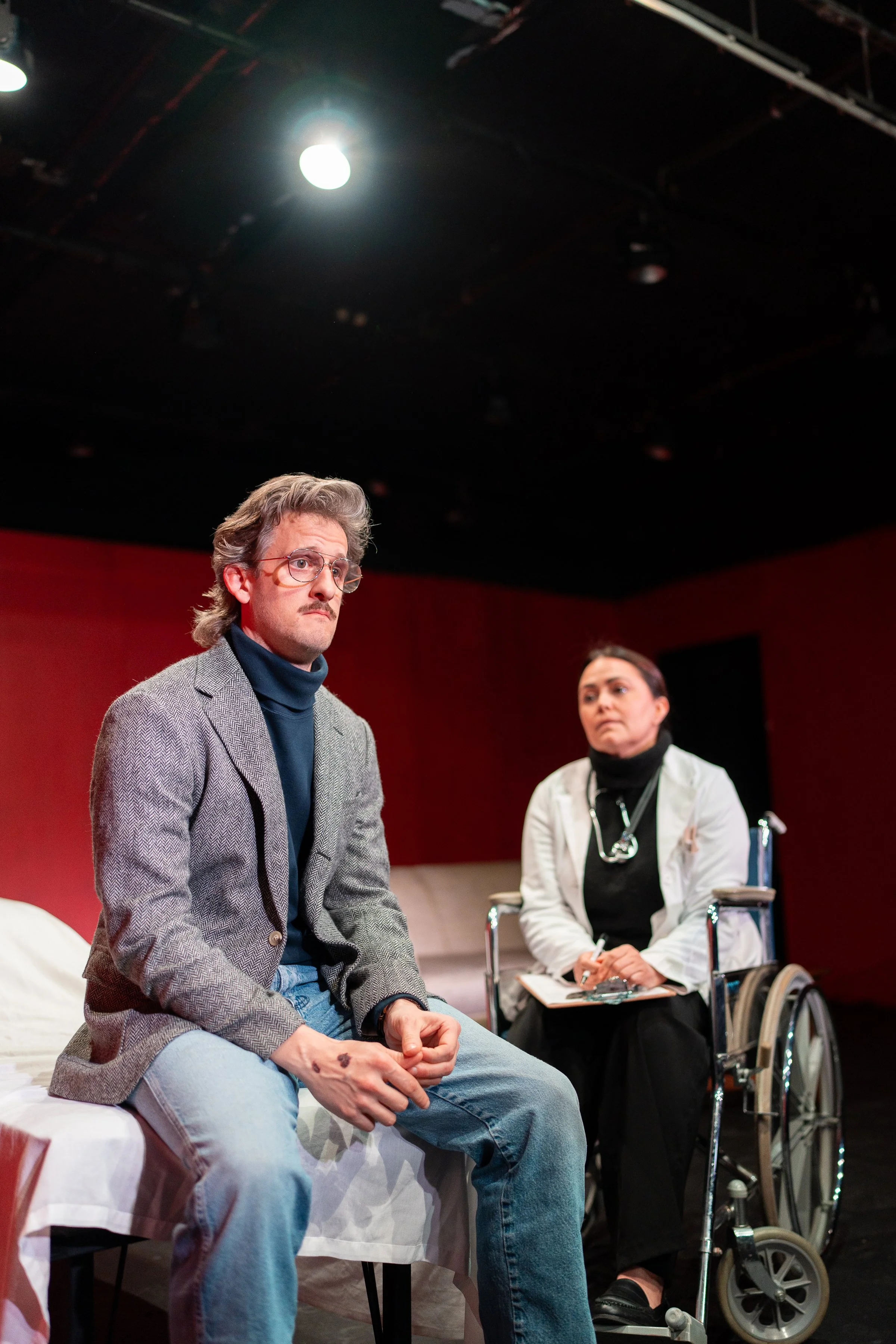
Felix Tuner (Reed Clapp) discussing a lack of treatment options with Dr. Emma Brookner (Casey Hardin).
“I said we’re all cowards! I said rich gays will give thousands to straight charities before they’ll give us a dime. I said it is appalling that some twenty million men and women don’t have one single lobbyist in Washington. How do we expect to achieve anything, ever, at all, by immaculate conception? I said the gay leaders who created this sexual-liberation philosophy in the first place
have been the death of us. Mickey, why didn’t you guys fight for the right to get married instead of the right to legitimize promiscuity? ”
Kameron Smith does a fine job taking on the role of Ned Weeks. Although I would have liked to see his anger have more layers of vocal inflection build up in Act 1, Smith boldly leads the audience to understand his gut-wrenching plight of needing to convince his own community of their need to make some changes. Changes, that will, at least temporarily, go against a lot of the liberation that they fought so hard to earn in decades past for the sake of their very lives. I applaud Mr. Smith for taking on such a demanding role early in his acting career. I look forward to seeing where his talents will lead him next.
Lakewood Theatre Company proves yet again that they know how to select shows that are both well fit for their venue and engaging for their audience base. I am grateful for lesser produced (in this region) works like this that Lakewood brings to life! Despite a bit of a lag in the tempo of the opening scene dialogues in particular, a good rhythm was found by the end of Act 1. I have no doubt that this production will only get stronger as the run continues through May 3, 2026. Please note this play is rated R and not suitable for young children. For tickets or more info, go to: www.lakewoodtheatre.org
**I would like to make mention that this show was dedicated to Cory Lambert and Tom Kiffney. Cory was a young man who took his own life after learning he had tested positive for HIV. Tom was an active member of Lakewood for many years. What a beautiful show to pay them both tribute with.